

Pre-Injection Screening and Safety
Patient safety is central to how injection therapy is delivered at Flex.
Before any ultrasound guided injection is booked, suitability is assessed either via a telephone screening consultation or a face to face clinical appointment. This allows us to confirm diagnosis, assess whether an injection is appropriate, screen for medical contraindications and discuss alternative options if needed.
If an injection is not the right option for you, this will be explained clearly and other management pathways discussed.
What is an Ultrasound Guided Injection?
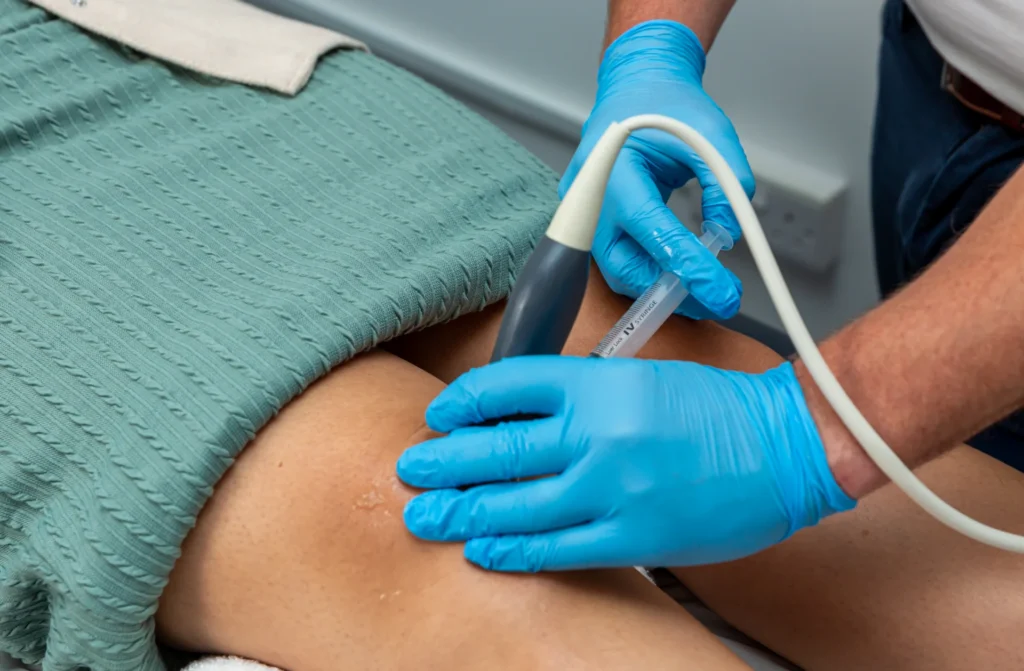
An ultrasound guided injection uses ultrasound imaging to guide a needle precisely into the correct anatomical structure, such as a joint, bursa or tendon sheath.
Ultrasound guidance allows the clinician to visualise the target structure in real time, avoid nearby nerves and blood vessels and confirm accurate placement before medication is delivered. This improves accuracy, consistency and safety and is considered best practice for many musculoskeletal injections.
Why Ultrasound Guidance Matters
Using ultrasound guidance allows us to:
- Visualise the exact structure being injected
- Avoid surrounding nerves, vessels and tendons
- Confirm accurate needle placement in real time
- Improve treatment reliability and safety
- Tailor injection choice to imaging findings
This is particularly important in complex joints or where multiple structures may be contributing to pain.
Types of Ultrasound Guided Injections We Offer
Steroid injections (corticosteroid)
Corticosteroid injections are used to reduce inflammation and pain in joints, bursa and irritated soft tissues.
Steroid injections are commonly used for:
- Bursitis, including trochanteric and subacromial bursitis
- Joint synovitis and inflammatory flare-ups
- Shoulder impingement and frozen shoulder pain
- Osteoarthritis related inflammation
- Tendon sheath irritation such as trigger finger or De Quervain’s
- Painful inflammatory episodes preventing movement or rehabilitation progress
Hyaluronic acid injections
Hyaluronic acid is a naturally occurring lubricant found in healthy joint fluid. When injected, it aims to restore lubrication and cushioning within the joint..
Hyaluronic acid injections are commonly used for:
- Knee osteoarthritis
- Hip, shoulder or ankle osteoarthritis
- Joint stiffness, grinding or mechanical pain related to wear and tear
They are often chosen by people seeking a non-steroid option for managing osteoarthritis symptoms.
Ostenil Plus
Ostenil Plus is a hyaluronic acid injection used to improve joint lubrication and cushioning.
It is typically used for:
- Knee osteoarthritis
- Shoulder osteoarthritis
- Hip or ankle osteoarthritis
It may help reduce pain, stiffness and movement related symptoms associated with joint wear.
Durolane
Durolane is a single-dose hyaluronic acid injection designed to last longer than many standard HA products.
It is commonly used for:
- Mild to moderate knee osteoarthritis
- Weight-bearing joints where longer-lasting symptom relief is desired
Durolane is often considered when previous hyaluronic acid injections helped but did not last long enough.
Sinovial®
Sinovial is a high-quality hyaluronic acid injection available in different viscosities
It is typically used for:
- Early to moderate osteoarthritis
- Joints requiring short to medium-term cushioning and lubrication
- Situations where stiffness and irritation are limiting movement
The formulation can be selected based on the joint involved, symptom severity and activity level.
Arthrosamid®
Arthrosamid is a long-lasting injectable hydrogel implant designed specifically for knee osteoarthritis.
Unlike steroid or hyaluronic acid injections, Arthrosamid does not degrade and remains within the joint lining, providing ongoing cushioning and mechanical support.
Arthrosamid is typically considered for:
- Knee osteoarthritis that is limiting daily life
- Persistent knee pain despite exercise based management
- People wanting to avoid or delay knee replacement surgery
- Patients seeking a longer-term non-surgical option
It is delivered as a single treatment and works best alongside rehabilitation and strength based management. Suitability is assessed carefully following clinical assessment and imaging.
Hydro-dilatation for frozen shoulder
Ultrasound guided hydro-dilatation is used specifically for frozen shoulder.
It is typically used for:
- Painful frozen shoulder with significant stiffness
- Markedly reduced shoulder movement affecting daily activities
The procedure stretches the tight joint capsule using fluid injection, helping reduce pain and improve range of motion.
Barbotage for calcific tendonitis
Ultrasound guided barbotage is used to treat calcific tendonitis, most commonly in the shoulder.
It is typically used for:
- Painful calcium deposits within rotator cuff tendons
- Calcific tendonitis causing night pain or restricted movement
The procedure uses ultrasound guidance to accurately access and break down calcium deposits, helping reduce pain and improve function.
What Type of Conditions Can Ultrasound Guided Injections Treat?
Hip
- Trochanteric bursitis or outer hip pain
- Hip osteoarthritis
- Femoroacetabular impingement related inflammation
- Iliopsoas bursitis or hip flexor irritation
- Hip joint synovitis
Knee
- Knee osteoarthritis
- Patellofemoral pain (pain around the kneecap)
- Meniscal irritation or meniscal related pain
- Iliotibial band (ITB) irritation
- Pes anserine bursitis (inner knee bursitis)
- Baker's cyst
- Knee joint synovitis (inflammation within the knee joint)
- Fat pad (Hoffa's) impingement
- Medial collateral ligament (MCL) irritation
- Lateral collateral ligament (LCL) irritation
- Proximal tibiofibular joint pain
- Patellar tendinopathy (jumper's knee) – where clinically appropriate
- Quadriceps tendinopathy – where clinically appropriate
Foot and ankle
- Foot and ankle osteoarthritis
- Plantar fasciitis or heel pain
- Morton’s neuroma
- Achilles tendinopathy
- Retrocalcaneal bursitis
- Peroneal tendinopathy
- Tibialis posterior tendon pain
- Ankle synovitis or post-sprain inflammation
Shoulder
- Shoulder osteoarthritis
- Shoulder impingement
- Subacromial bursitis
- Frozen shoulder
- Calcific tendinitis
- Rotator cuff tendinopathy
- Acromioclavicular joint pain
- Biceps tenosynovitis
Elbow
- Tennis elbow
- Golfer’s elbow
- Cubital tunnel related irritation
- Triceps tendon irritation
Hand and wrist
- Hand and wrist osteoarthritis
- De Quervain’s tenosynovitis
- Carpal tunnel syndrome
- Trigger finger or trigger thumb
- Thumb base osteoarthritis
- Wrist tendinitis
- Painful ganglion cyst irritation
What Injections Are Not Suitable For
- Areas with active infection, broken skin, or inflammation of the skin
- Fractures or acute injuries that require imaging, protection, or rest
- Significant tendon or muscle tears, where injection may interfere with healing
- Generalised or non-specific pain without a clearly defined target
- Systemic or inflammatory conditions better managed through medical care
- Areas where medical contraindications exist
Ultrasound Guided Injections
Clinical Assessment, Screening and Consent
Before your injection is booked, you will undergo a thorough clinical screening either face to face or via a telephone consultation. This includes a detailed review of your symptoms, medical history, current medications and any relevant imaging. On the day of your appointment, your clinician will reconfirm suitability, answer any remaining questions and guide you through a comprehensive consent process. You will have been sent a consent form via the confirmation email for the appointment to complete prior to the injection.
Physical Examination, Ultrasound Assessment and Target Confirmation
A comprehensive physiotherapy assessment is essential before any ultrasound-guided injection. This is followed by a diagnostic ultrasound scan to clearly visualise the affected joint or soft tissue. Ultrasound allows the clinician to confirm the exact source of symptoms, assess surrounding structures, and carefully plan the safest and most effective injection approach.
Procedure Explanation, Risks and Aftercare
Your clinician will clearly explain what will happen during the injection, what sensations to expect and what you should and should not do afterwards. Potential risks and side effects are discussed again, ensuring you feel fully informed and comfortable before treatment proceeds.
Ultrasound Guided Injection
The injection is performed under real time ultrasound guidance using sterile technique. Ultrasound allows precise needle placement while avoiding nearby nerves, blood vessels and sensitive structures.
Post Injection Advice and Rehabilitation Planning
After the injection, you will receive clear guidance on activity modification, pain expectations and recovery timelines. Your clinician will discuss the role of physiotherapy and rehabilitation, outlining next steps to maximise the benefit of the injection and support long term recovery.
Injections and Rehabilitation
Injections are used to create a window of opportunity for rehabilitation by reducing pain or inflammation.
They are most effective when combined with physiotherapy, rehabilitation exercises, load management and activity modification. Injection alone does not address the underlying cause of most musculoskeletal problems.
Ultrasound Scanning and Guided Injections - Flex Physiotherapy Burgess Hill
Ultrasound Guided Injection FAQs
Are injections screened before booking?
Yes. All injections are screened either over the phone or face to face before booking to ensure they are appropriate and safe. This includes a review of your symptoms, medical history and suitability for injection therapy.
Do I need a referral from my GP or consultant?
No. You can self-refer for ultrasound guided injections. If further medical input is required, we will advise you appropriately.
What happens before the injection is authorised?
Before booking, your case is reviewed either during a telephone consultation or face to face appointment. This includes a review of your medical history, medications and any relevant imaging, followed by authorisation to proceed if appropriate.
Is consent included?
Yes. A thorough consent process is completed before treatment. This includes discussion of benefits, risks, alternatives and aftercare, ensuring you feel fully informed before proceeding.
Are there side effects?
Side effects are usually mild and temporary. These may include a short-term pain flare, bruising or soreness at the injection site. Infection and serious complications are rare and will be discussed with you before treatment.
Is ultrasound guided injection safe?
Yes. Ultrasound guidance improves accuracy and safety by allowing the clinician to see the target structure in real time and avoid nearby nerves and blood vessels. All injections are performed using sterile technique.
How long does it take for an injection to work?
This depends on the type of injection and the condition being treated. Some people notice improvement within days, while others may take several weeks to feel the full benefit. Your clinician will explain what to expect for your specific injection.
How long do the effects of an injection last?
Relief can last weeks or months depending on the injection type, the condition and how the area is managed afterwards. Injections tend to work best when combined with rehabilitation rather than used in isolation.
Will the injection cure my problem?
Injections are designed to reduce pain or inflammation and create an opportunity for recovery. They do not cure most musculoskeletal conditions on their own. Addressing strength, movement and loading through physiotherapy is essential for long-term improvement.
Is physiotherapy recommended after an injection?
Yes. Physiotherapy and rehabilitation are strongly recommended to maximise long-term benefit, address the underlying cause of symptoms and reduce recurrence.
Can I return to normal activity straight after an injection?
You may be advised to modify activity for a short period after your injection. This varies depending on the injection type and location. Clear aftercare guidance will be provided on the day.
How many injections can I have?
This depends on the type of injection, the tissue involved and your overall treatment plan. Your clinician will discuss safe limits and alternative options if repeat injections are not appropriate.
Are ultrasound guided injections covered by insurance?
In most cases, ultrasound guided injections are not covered by health insurance providers. We recommend checking directly with your insurer if you are unsure.
How much do injections cost?
Costs vary depending on the type of injection. Please see our pricing page for up-to-date fees.
Can injections delay surgery?
In some cases, injections may help reduce symptoms and delay the need for surgery. This depends on the condition, severity and individual circumstances.
Will I receive a report or summary after my injection?
Yes. Key findings, treatment details and next steps can be shared with you and, with your consent, communicated to your GP or consultant if required.
What if an injection is not the right option for me?
If an injection is not appropriate, this will be explained clearly. We will discuss alternative management options such as physiotherapy, rehabilitation, imaging or referral to another specialist where necessary.
What areas do you cover for ultrasound guided injections?
We regularly see patients from Burgess Hill, Mid Sussex, Haywards Heath, Hassocks, Brighton and Hove, Crawley and surrounding areas. Due to direct train links and road access, we also treat patients travelling from London, Surrey, Kent and across the South East who are seeking specialist ultrasound guided injections and musculoskeletal care.