
Force Plates
Service
Force Plate Testing in Burgess Hill
Force plate testing gives us clear information about how you move, jump, land and produce force. It can be useful for people of all ages and abilities, from those recovering after injury or surgery to runners, gym-goers and athletes looking to improve performance.
Force plate testing provides precise, objective insight into how your body produces force, absorbs load and controls movement. At Flex Physiotherapy Burgess Hill, we use advanced force plate technology to assess strength, balance, asymmetry and movement strategy in a way that cannot be identified through observation alone.
Force plate testing plays a central role in modern rehabilitation, injury risk management and return to sport decision making. It allows rehabilitation to be guided by data rather than symptoms alone, ensuring progress is measurable, meaningful and appropriate to the demands of activity and sport.
Testing at Flex is fully bookable, either as a standalone assessment, as part of a recommended double testing pathway, or integrated within a structured Advanced Rehab programme with testing at both the start and end.
We support patients and athletes from Burgess Hill, Mid Sussex, Brighton and the surrounding areas.
What Are Force Plates?
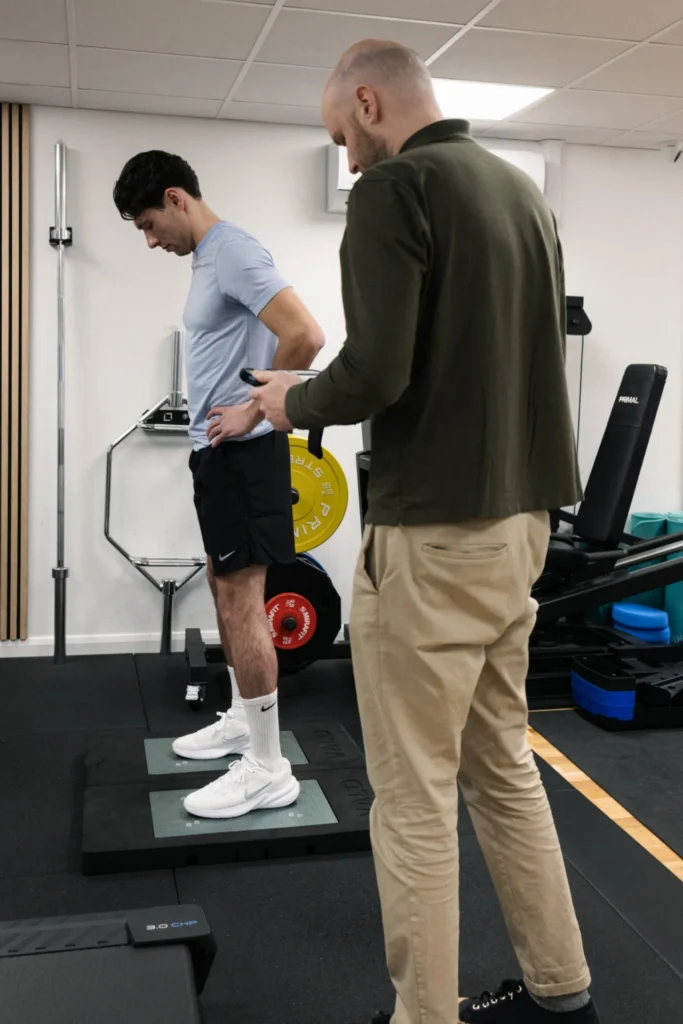
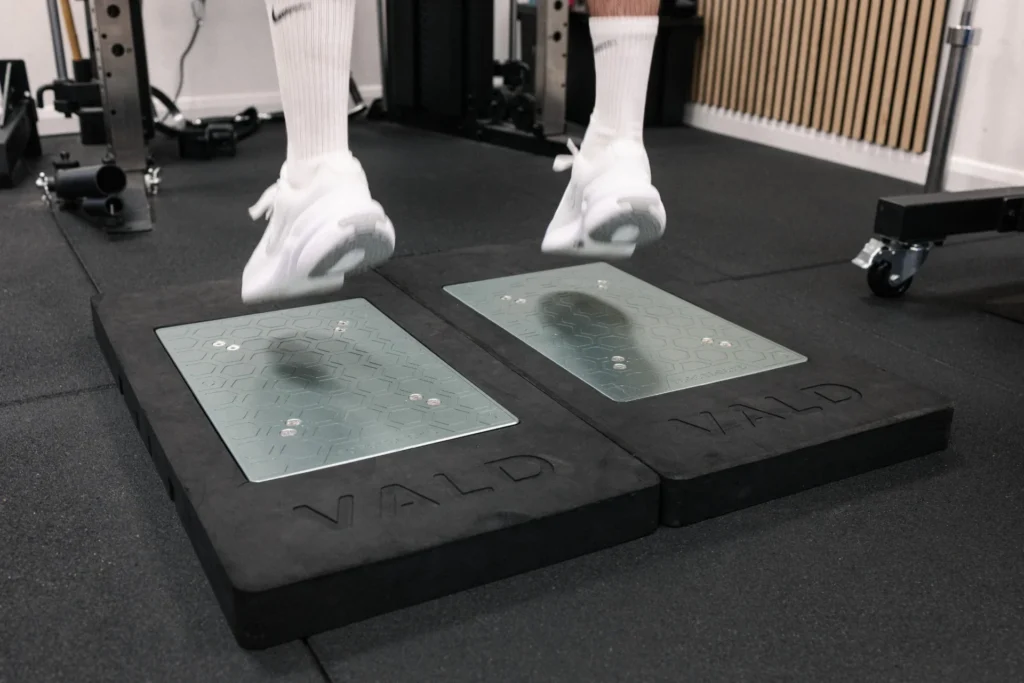
Force plates are highly sensitive platforms that measure how much force you produce against the ground, how quickly you generate it and how evenly that force is distributed between limbs.
Unlike visual assessment, force plates provide numerical data on strength, power, balance and asymmetry. This allows clinicians to identify deficits that may increase injury risk or limit performance, even when movement looks normal.
At Flex, we use force plate testing routinely within rehabilitation, return to running and return to sport pathways, reflecting standards used in elite sport and high performance environments.

Why Force Plate Testing Matters in Rehabilitation
Pain and symptoms alone are a poor guide for rehabilitation progression. Many people feel better before their tissues are ready to tolerate load, speed or impact.
Force plate testing allows us to:
- Quantify strength and loading capacity
- Identify side to side asymmetries
- Measure how force is produced and absorbed
- Track objective progress over time
- Compare results against age and sex normative data
- Make safer return to activity and return to sport decisions
This data driven approach reduces guesswork and improves confidence for both clinician and patient.
Force Plate Tests We Use
Want to see what force plates can reveal about your strength, balance and injury risk? Explore the tests below to understand how they guide rehabilitation and return to sport.
Jump and landing tests
Jump based tests assess how forcefully and efficiently you generate power and how well you absorb load when landing. These measures are critical for sports and activities involving jumping, sprinting and change of direction.
Commonly used for ACL injury and reconstruction, Achilles tendon injuries, patellar tendinopathy, hamstring injuries, ankle instability and return to running. These tests help identify limb loading asymmetry, reduced power and poor landing control that increase re injury risk.
Single leg strength and asymmetry testing
Single leg testing reveals side to side differences that are often hidden during double leg exercises. Even when movement appears symmetrical, force plate data may show one limb is still avoiding load.
These tests are essential following surgery, tendon injuries, hip, knee and ankle injuries, persistent pain and recurrent injuries. They guide rehabilitation progression and return to sport decision making.
Balance and movement control testing
Balance testing measures postural control, weight distribution and stability strategies. This information is particularly useful in early stage rehabilitation and for individuals lacking confidence in the injured limb.
Commonly used for ankle sprains and instability, knee injuries, lower limb overuse injuries and return to impact activity.
Rate of force development and load tolerance
Force is not just about how much you can produce, but how quickly you can produce it. This matters for acceleration, deceleration and reactive movement.
This testing is highly relevant for sprinting sports, cutting and change of direction, return to high speed running and late stage return to play rehabilitation.
Re testing and benchmarking progress
Force plate testing becomes most powerful when repeated. Re testing allows progress to be confirmed objectively rather than relying on pain or time alone.
Results can be compared to previous tests and, where appropriate, age and sex normative data. This supports safe progression and confident return to activity or sport.
Force Plates FAQs
Linking force plate data to real world rehabilitation
Data alone is meaningless without context. At Flex, force plate results are always interpreted alongside clinical assessment, movement analysis and your goals.
Testing sessions are often used as standalone assessments to guide a rehabilitation plan, with repeat testing later to objectively confirm improvement.
Force plate data informs:
- Exercise selection and progression
- Load management and capacity building
- Return to running programmes
- Return to sport decision making
- Long term injury prevention strategies
Integrated testing and rehabilitation in our on site gym
Force plate testing at Flex is fully integrated with rehabilitation in our state of the art on site gym.
This allows us to assess performance, prescribe targeted exercises immediately, progress loading safely and re test to confirm adaptation. Having assessment, testing and rehabilitation in one space creates a seamless pathway from diagnosis to recovery and return to performance.
How to book force plate testing and advanced rehabilitation
Force plate testing can be accessed in several ways depending on whether you want insight, structured rehabilitation or a complete return to sport pathway.
Advanced Rehab and Performance Assessment (single appointment)
A 45 minute standalone assessment designed to provide objective insight into your strength, balance and functional capacity.
This includes force plate testing, hand held dynamometry and capacity based functional testing. Results are explained clearly and used to provide targeted recommendations.
This option is ideal if you want data first before deciding on rehabilitation.
Advanced Rehab and Performance Assessment (recommended double appointment)
This is our recommended pathway for most people planning rehabilitation.
The first session establishes a clear baseline using advanced testing. This data is used to design a precise, individualised rehabilitation or performance programme. A follow up testing session later allows progress to be measured objectively.
This approach is particularly valuable for return to sport, tendon injuries, post surgical rehabilitation and recurrent or complex injuries.
Advanced Rehab and Performance Block (6 sessions)
This is our most comprehensive option and provides a structured, data driven rehabilitation pathway with testing either side of your programme.
The block includes:
- An initial baseline testing session
- Four targeted rehabilitation sessions in our on site gym
- A final re test session to measure progress and guide safe return to activity or sport
This option is ideal for those seeking a higher level of assessment, supervised rehabilitation and measurable outcomes, with access to technology rarely available outside professional sport.
Who benefits from force plate testing?
Force plate testing is valuable for:
- Athletes returning from injury
- Recreational runners and gym users
- Post surgical patients
- People with recurrent or persistent injuries
- Individuals preparing for return to sport
- Anyone who wants objective insight into their physical capacity
Why choose Flex for force plate testing?
- Access to advanced force plate technology
- Used in elite sport and high performance environments
- Data interpreted by experienced physiotherapists
- Integrated with hands on treatment and rehabilitation
- Objective benchmarking and repeat testing
- On site gym for supervised progression